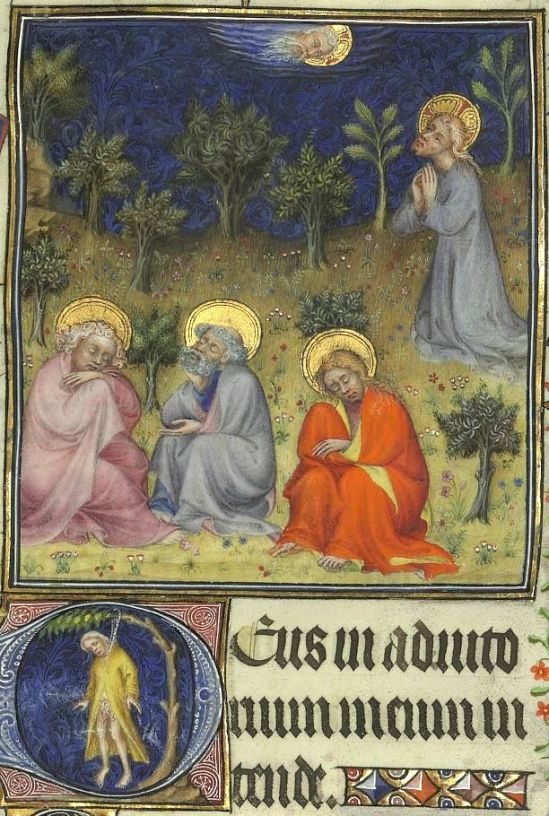
Agonie de Jésus au jardin des oliviers
| ℣. Deus, in adjutórium meum inténde. | ℣. Dieu, venez à mon aide. |
| ℟. Dómine, ad adjuvándum me festína. Glória Patri, & Fílio, & Spirítui Sancto. Sicut erat in princípio, & nunc, & semper, & in sæcula sæculórum. Amen. Alleluia. (A Septuagesima usque ad Pascha, loco Alleluia dicitur :) Laus tibi, Dómine, rex ætérnæ glóriæ. | ℟. Seigneur, hâtez-vous de me secourir. Gloire au Père, & au Fils, & au Saint Esprit. Comme il était au commencement, & maintenant & toujours, & dans les siècles des siècles. Ainsi soit-il. Alléluia. (De la Septuagésime à Pâques, au lieu d’Alléluia :) Louange à vous, Seigneur, Roi d’éternelle gloire !). |
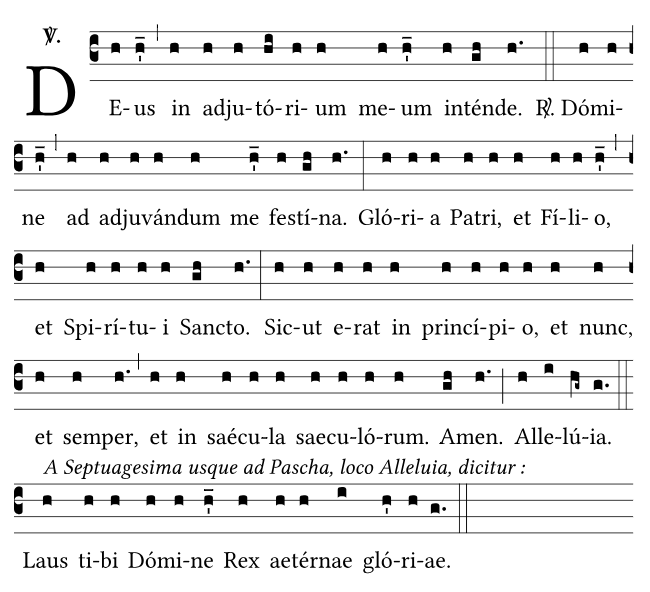
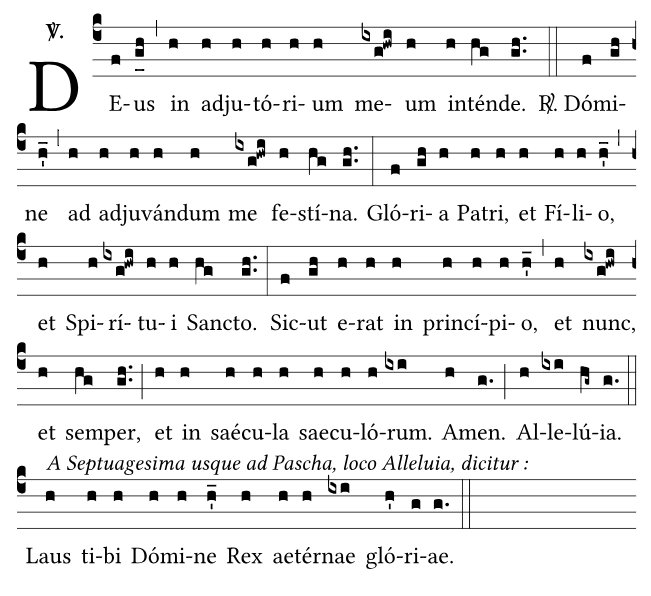
Introitus: Deus in adiutorium
« Deus, in adiutorium meum intende« , with the response « Domine, ad adiuvandum me festina » (respectively, « O GOD, come to my assistance » and « O LORD, make haste to help me ») are the first verse of Psalm 70 (Psalm 69 in the Vulgate): « Make haste, O GOD, to deliver me; make haste to help me, O LORD. » In this form they are a traditional Latin Christian prayer.
These words form the introductory prayer to every Hour of the Roman, Ambrosian, and monastic Breviaries, except during the last three days of Holy Week, and in the Office of the Dead. While these are recited or sung, all present bless themselves with the sign of the cross.
Tradition says that Benedict of Nursia introduced this custom into the monastic Office, heavily influenced by the writings of Saint John Cassian. Saint Gregory the Great extended it to all the Roman churches. Saint John Cassian (Coll., X, 10) wrote that from the earliest Christian times the monks used this introduction very often, including outside of the liturgical prayers, as an invocation for every situation, for times of temptation, tiredness, and joy.
https://en.wikipedia.org/wiki/Deus,_in_adiutorium_meum_intende
Pour le rosaire
En introduction du rosaire, il est aussi d’usage de réciter cette prière à la place du credo, plus long. L’illustration du haut de page nous renvoie plus précisément au sixième mystère, celui de l’agonie de Jésus au jardin des oliviers.
 Nature, Poésie, IA et Christianisme